Timeplapsed screen recordings from MOPHH Chamber Experiment 2026
MOPHH Chamber Experiment was produced for Metals and Oxygen: Planetary and Human Homeostasis, a special meeting at The Royal Society, London in June 2026
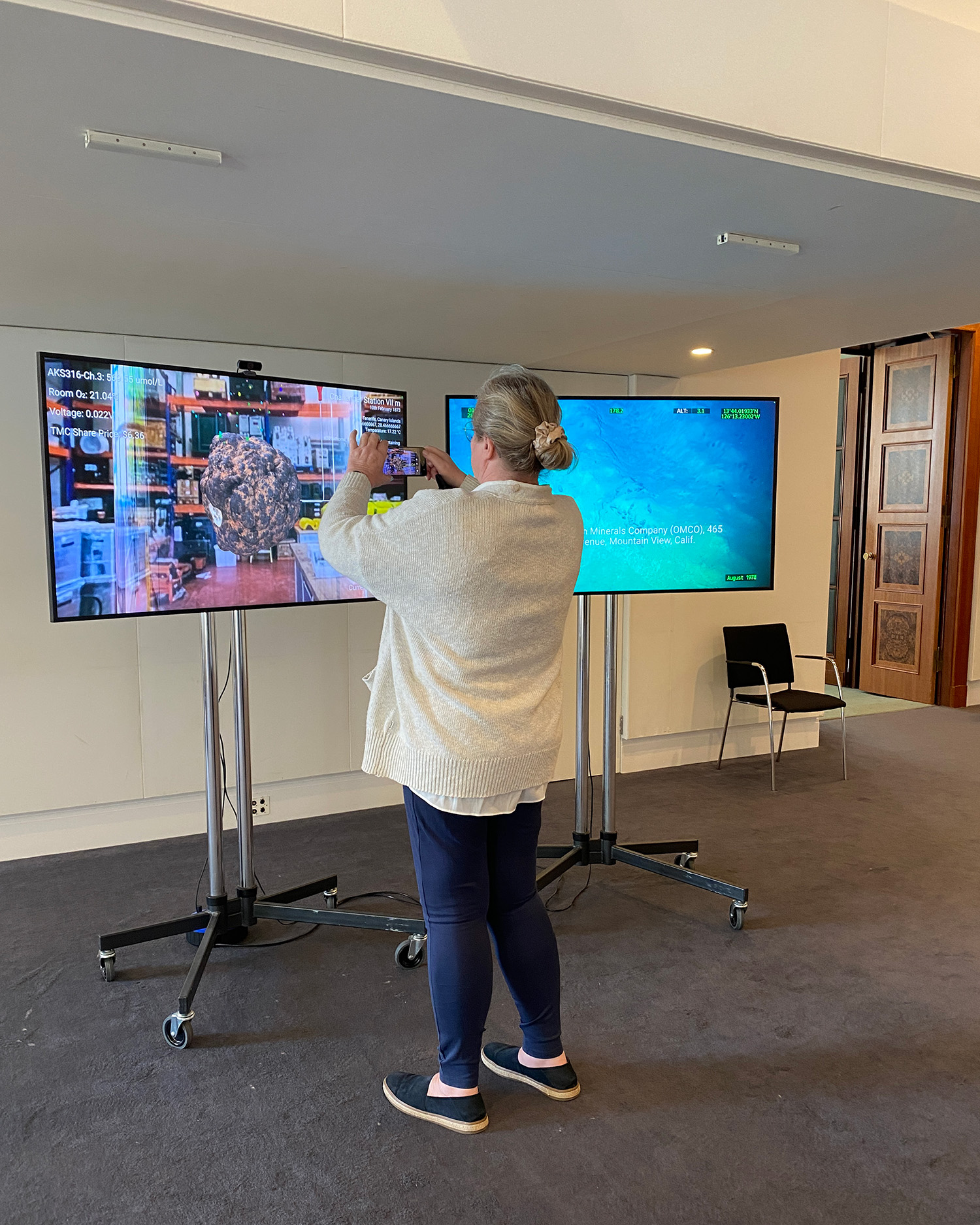
This data driven artwork centres on a polymetallic nodule collected during the HMS Challenger expedition, a nineteenth century voyage organised by The Royal Society that helped shape Oceanography as a scientific discipline. 150 years later these nodules have returned to the centre of scientific debate through the discovery of Dark Oxygen (Sweetman et al 2024) - oxygen being produced by these nodules independent of sunlight 4500m below the surface of the Pacific Ocean.
Sweetman’s unexpected discovery not only challenges existing understandings of oxygen production in the deep ocean but it creates a shift in how these nodules are perceived. They can no longer be characterised as inert lumps of matter that can be plucked from the ocean floor, but instead demand to be understood as active participants in the formation of deep sea ecosystems. At a moment when interest in exploiting the deep-ocean is increasing, this emerging geochemical agency becomes a new contact zone between scientific discovery, industry, and policy, in which the future of deep sea mining is being contested today.
The artwork draws a range of data sources into it - the daily share price of a deep sea mining company, sea surface temperatures measured by the Copernicus Satellite Program, the HMS challenger report, Sweetman’s Optode readings - what emerges is a synthetic site that explores how knowledge of polymetallic nodules is produced, where it is situated and how that knowledge might shape future decisions about the deep ocean.
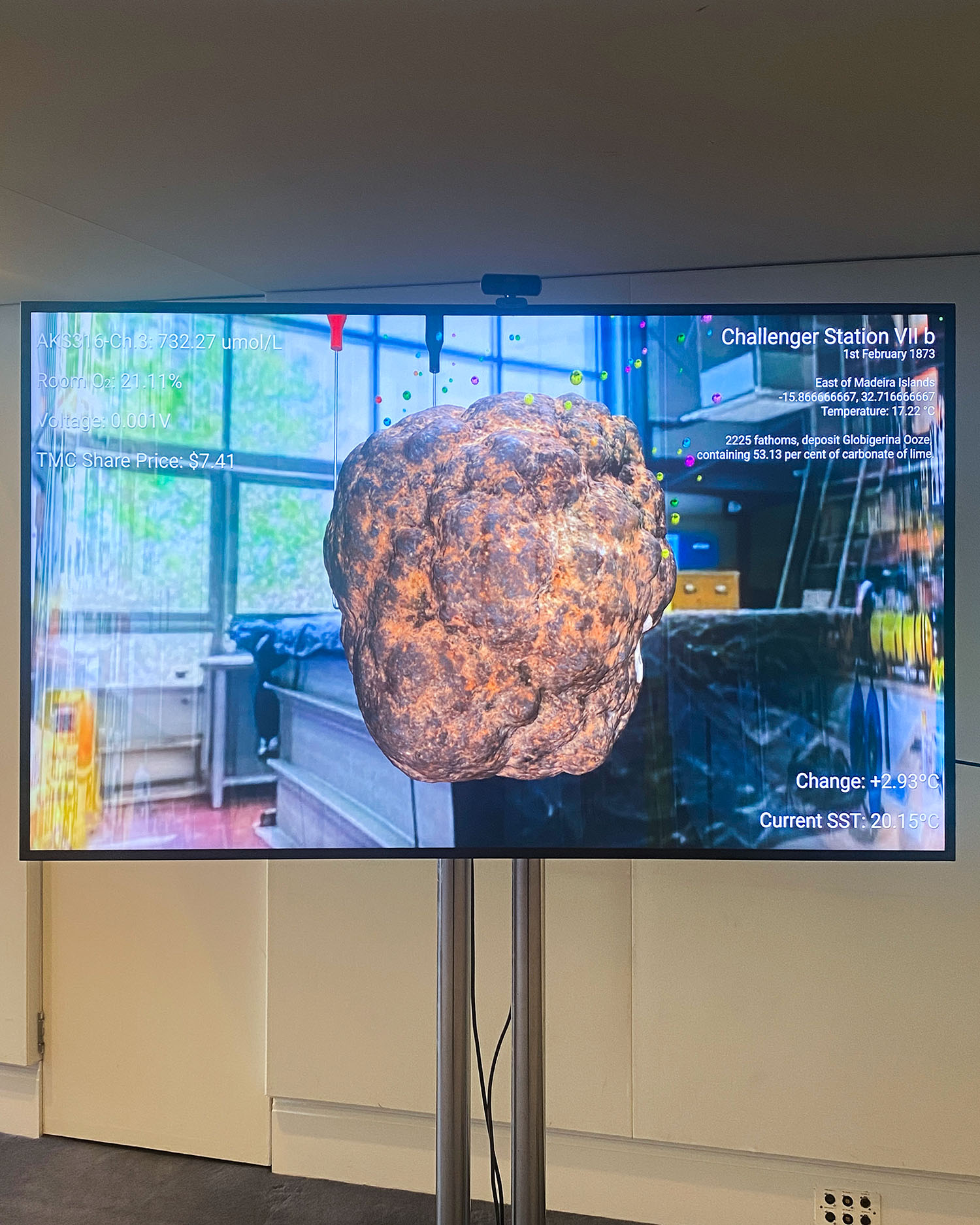
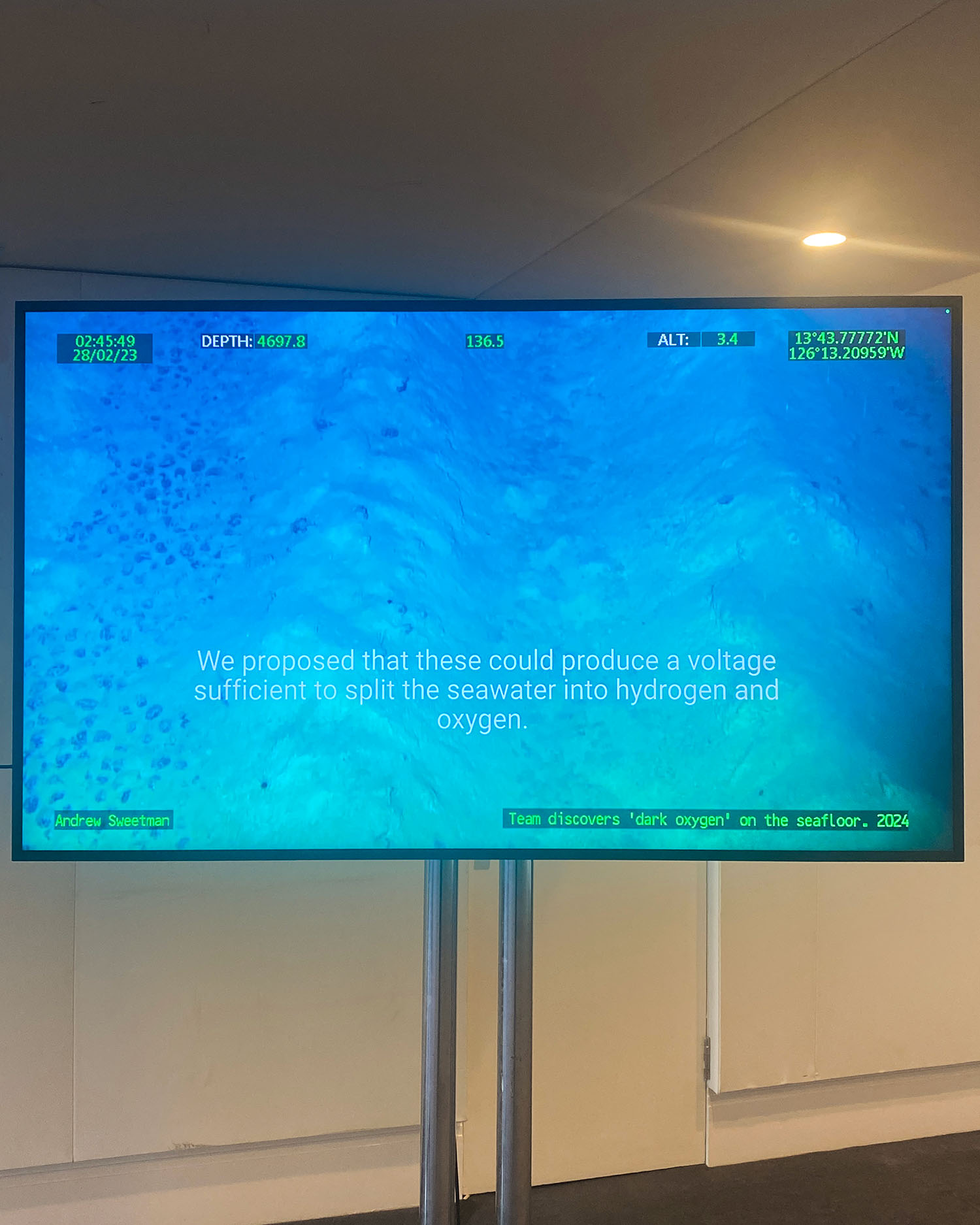
Screens installed in the Meeting Room at The Royal Society, June 2026
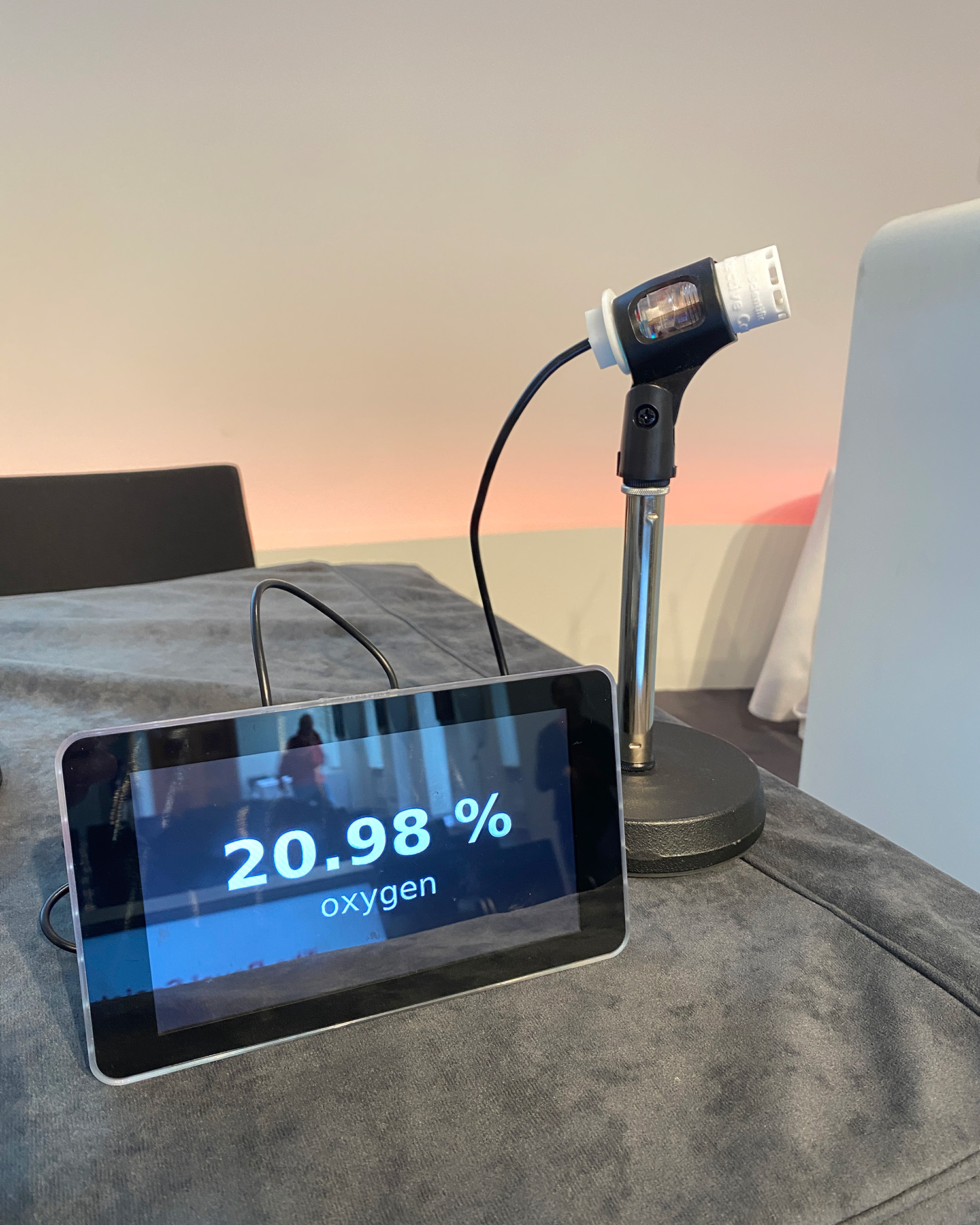
A digital oxygen sensor monitored and displayed the oxygen level in the room during the meeting and transmitted the data to the artwork.
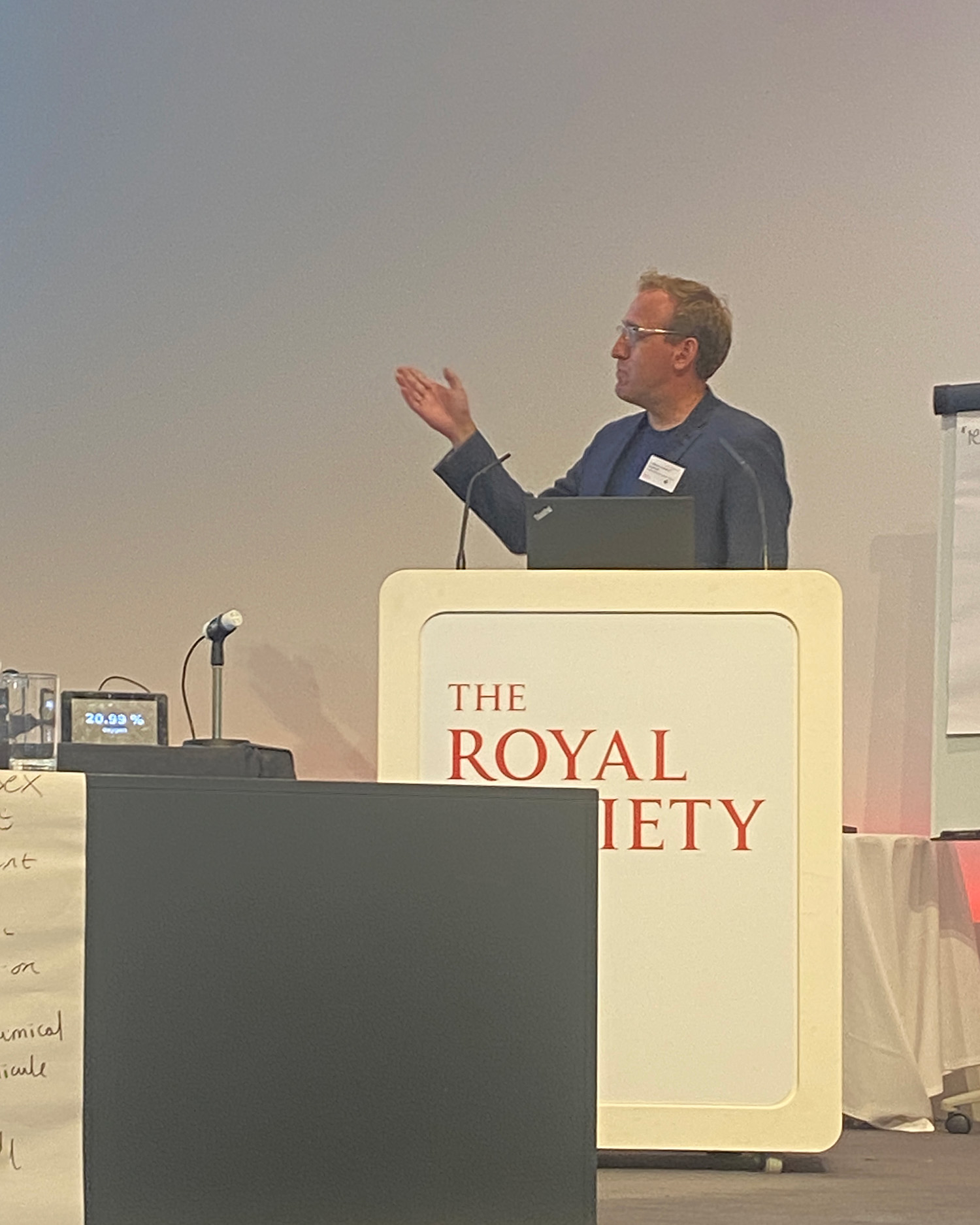
Professor Andrew K.Sweetman presents his paper on Dark Oxygen Production.
Chemical Composition of Manganese nodules from Challenger Station 248 mapped to particle colour in animation
| Mineral | % Composition | Colour |
|---|---|---|
| Lost on ignition after drying (organic) | 16.5% | |
| Alumina | 2.5% | |
| Ferric Oxide | 20.5% | |
| Manganese Oxide | 22.5% | |
| Calcium Sulphate | 0.85% | |
| Calcium Carbonate | 2.65% | |
| Magnesium Carbonate | 1.1% | |
| Silica | 29.1% | |
| Lime | 0.65% | |
| Magnesia | 0.32% |
Fig1: Manganese Nodules. Station 248. Lat. 37° 41' N., long. 177° 4' W., 2900 fathoms (Brazier). HMS Challenger Report on Deep Sea Deposits 1891 p.467
Data Sources:
Barron, G. (2025) Securing American Mineral Future: From Dependence to Dominance. Testimony before the House Committee on Natural Resources, Subcommittee on Oversight and Investigations, hearing “Exploring the Potential of Deep-Sea Mining to Expand American Production”, United States House of Representatives, 29 April. Washington, D.C.: U.S. Government Publishing Office. Available at: https://docs.house.gov (Accessed: 12 June 2026).
Challenger Office (1895) Report on the Scientific Results of the Voyage of H.M.S. Challenger during the years 1873–76: Summary of the Scientific Results, Part II. London: HMSO. Available at: HathiTrust Digital Library (Accessed: 12 June 2026)
Copernicus Marine Service (CMEMS). Global Ocean OSTIA Sea Surface Temperature and Sea Ice Analysis (Dataset: METOFFICE-GLO-SST-L4-NRT-OBS-SST-V2). DOI: 10.48670/moi-00165. Accessed 15 June 2026.
Deep-Sea Mining Science Statement (2025) Open Letter: Deep-Sea Mining Science Statement. Available at: https://seabedminingsciencestatement.org (Accessed: 12 June 2026).
Fleming, B.; Van Audenhaege, L.; Simon-Lledo, E.; Jones, D. (2025): Benthic images recorded by a Remotely Operated Vehicle video camera during cruise JC241 in the eastern Clarion-Clipperton Zone (Pacific Ocean, 2023). NERC British Oceanographic Data Centre, 11 February 2025. doi:10.5285/2de087c9-cee3-87f4-e063-7086abc0f9a9. https://dx.doi.org/10.5285/2de087c9-cee3-87f4-e063-7086abc0f9a9
International Seabed Authority (ISA) (2025) Statement on the US Executive Order “Unleashing America’s Offshore Critical Minerals and Resources”. Statement by Ms Leticia Reis de Carvalho, Secretary-General of the International Seabed Authority, 30 April. Available at: https://isa.org.jm/news/statement-on-the-us-executive-order-unleashing-americas-offshore-critical-minerals-and-resources/ (Accessed: 12 June 2026).
Kaho‘ohalahala S. Dark Oxygen (2024) The Energy Comes from the Deep Sea https://www.instagram.com/reels/C-A-NW3NyBB/ (accessed 12 June 2026)
Murray, J. (n.d.) Diary of John Murray. National Library of Australia, nla.obj-2123382978. Available at: http://nla.gov.au/nla.obj-2123382978 (Accessed: 12 June 2026).
Murray, J. & Renard, A. F. (1891) Report on Deep-Sea Deposits based on the specimens collected during the voyage of H.M.S. Challenger 1873–1876. Report on the Scientific Results of the Voyage of H.M.S. Challenger, Volume III. London: Her Majesty’s Stationery Office.
Ocean Minerals Recovered from Floor of Pacific, Maritime Reporter and Engineering News (1978) August issue, p. 36. Available at: https://magazines.marinelink.com/Magazines/MaritimeReporter/197808/flash/html5forpc.html?page=36 (Accessed: 12 June 2026).
Roscoe and Fleming, ‘Can we vacuum-clean the sea floor for valuable ore?’, Popular Science (1959) 102. https://books.google.co.uk/books?id=KioDAAAAMBAJ&pg=PA2
Sweetman, Andrew (2024). Data from replicate benthic chamber experiments conducted at abyssal depths across the Clarion Clipperton Zone (CCZ), Pacific Ocean [Dataset]. Dryad. https://doi.org/10.5061/dryad.tdz08kq6w
Sweetman, A. (2025) My team discovered ‘dark oxygen’ on the seafloor – now we’re trying to understand how it was made. https://theconversation.com/my-team-discovered-dark-oxygen-on-the-seafloor-now-were-trying-to-understand-how-it-was-made-250445 (Accessed: 12 June 2026).
Yahoo Finance (2026) The Metals Company (TMC) historical stock price data (daily adjusted close). Available via Yahoo Finance API. Accessed using Python yfinance/pandas-datareader. Available at: https://finance.yahoo.com (Accessed: 15 June 2026).